Liquid Marbles
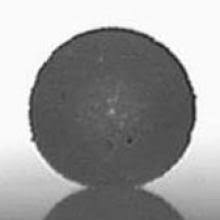
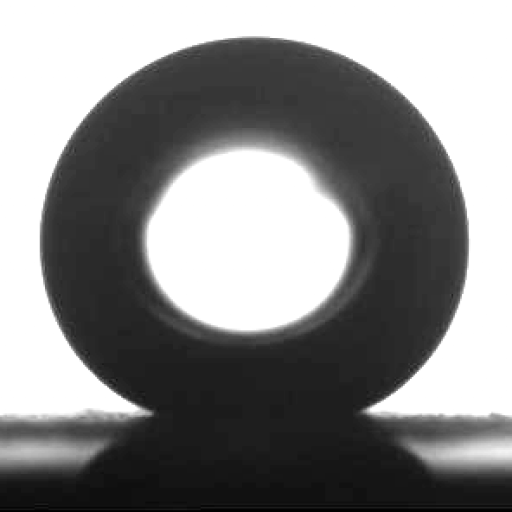
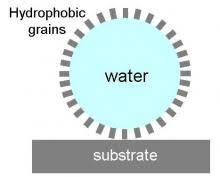
‘Hydrophobic’ is usually taken to mean ‘water-fearing’, but hydrophobic grains stick to the surface of water. If the grains forming a hydrophobic surface are loose, rather than fixed, a droplet of water rolling across the surface will become encapsulated by the grains. This is known as a liquid marble can be formed in which a ‘ball’ of water is encased in a granular coating. A droplet of water rolling across the surface becomes encapsulated by the grains., as illustrated schematically in the image below.
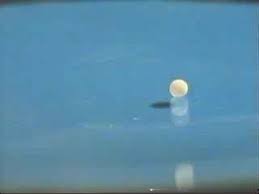
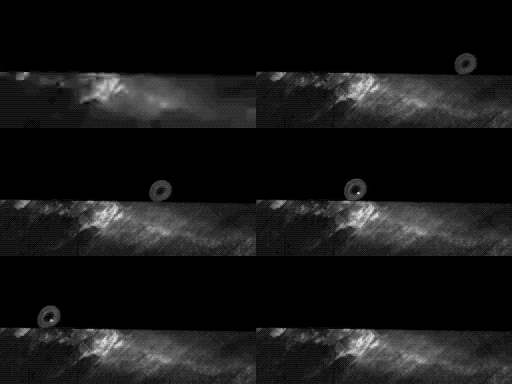
Liquid marbles are completely mobile and roll freely on solid (and water) surfaces, as seen below.

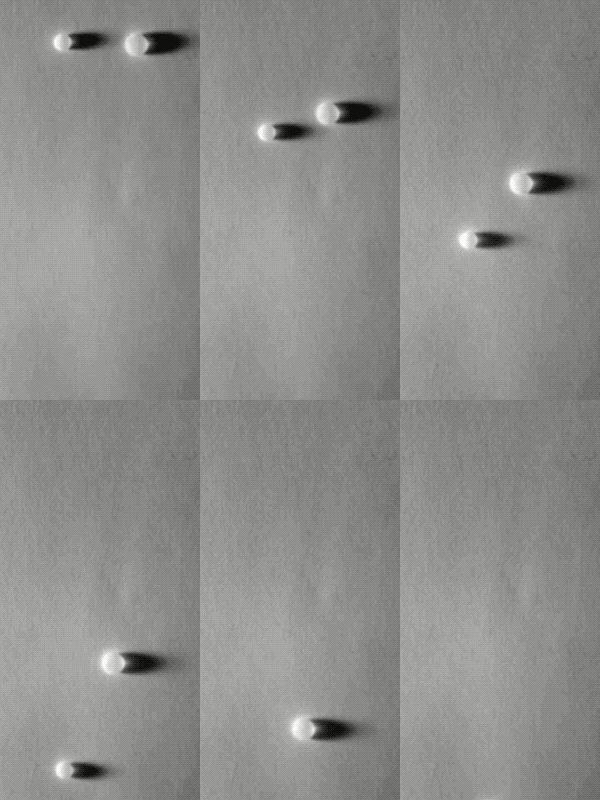
Professor Quéré and co-workers have shown that small liquid marbles roll down hill faster than larger ones, as shown below. This is the opposite of what would be expected for solid marbles.
Liquid marbles occur naturally and are used by galling aphids as a waste disposal system for the honeydew they secrete – read more about gall aphids here.
Publications
- Liquid Marbles P. Aussillous and D. Quéré, Nature 411 (2001), 924-927
- Electrowetting of non-wetting liquids and liquid marbles G. McHale, D.L. Herbertson, S.J. Elliot, N.J. Shirtcliffe and M.I. Newton, Langmuir 23 (2007) 918-924
- Liquid Marbles: Principles and applications G. McHale and M.I. Newton, Soft Matter 7 (2011) 5473-5481
- Liquid marbles: topical context within soft matter and recent progress G. McHale and M.I. Newton, Soft Matter 11 (2015) 2530–2546