Anti-Icing Liquid-like Surfaces
Ice formation and accumulation widely in the natural environment and is dangerous when it occurs on planes and essential infrastructure, such as power lines and bridges [1]. Surfaces can be heated, but this is energetically expensive. Surfaces can be painted black so the sun does the heating – at least when the seasons and times of day allows it to shine. One strategy is to use a passive coating which prevents ice formation or makes it easier to remove alongside an active approach, such as electrical heating, acoustic waves or pneumatically-operated “mechanical boots”.
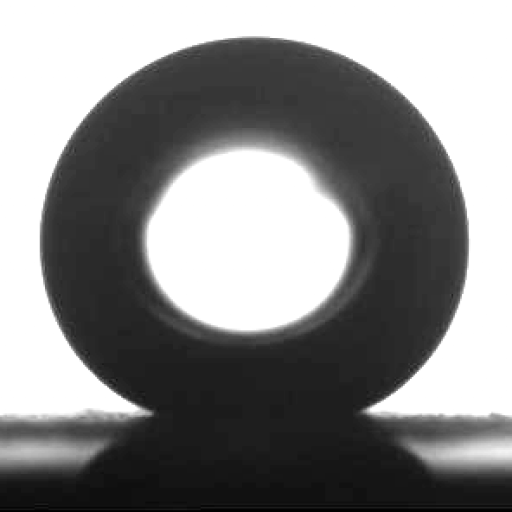
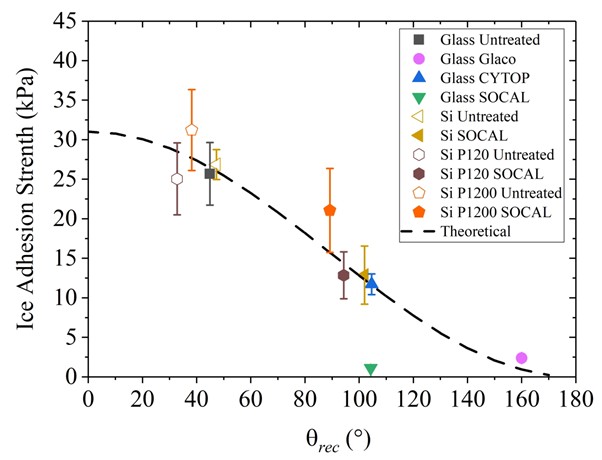
For coatings, it is believed the practical work of adhesion, Wadh=γLV(1+cos θrec), determined by the water receding contact angle, θrec, might correlate with the ice adhesion strength [2]. The figure above shows the one of the best hydrophobic coatings in reducing ice adhesion strength (Cytop – Blue triangle ) is outperformed by both a superhydrophobic coating (Glaco – Purple circle) and a slippery omniphobic covalently attached liquid-like coating (SOCAL – Green triangle) [3].
Publications
- Advances in Hybrid Icing and Frosting Protection Strategies for Optics, Lens, and Photonics in Cold Environments Using Thin‐Film Acoustic Waves H. L. Ong, Z. Ji, L. Haworth, Y. Guo, J. del Moral, S. Jacob, A. Borras, A. R. Gonzalez‐Elipe, J. Zhang, J. Zhou, G. McHaleamd Y. Fu Advanced Engineering Materials (2025), 2402139
- Relationships between Water Wettability and Ice Adhesion A. J. Meuler, J. D. Smith, K. K. Varanasi, J. M. Mabry, G. H. McKinley and R. E. Cohen ACS Applied Materials & Interfaces 2 (2010), 3100–3110
- Reduction of ice adhesion on nanostructured and nanoscale slippery surfaces L. Haworth, D. Yang, P. Agrawal, H. Torun, X. Hou, G. McHale and Y. Fu, Nanotechnology and Precision Engineering 6 (2023), 013007